


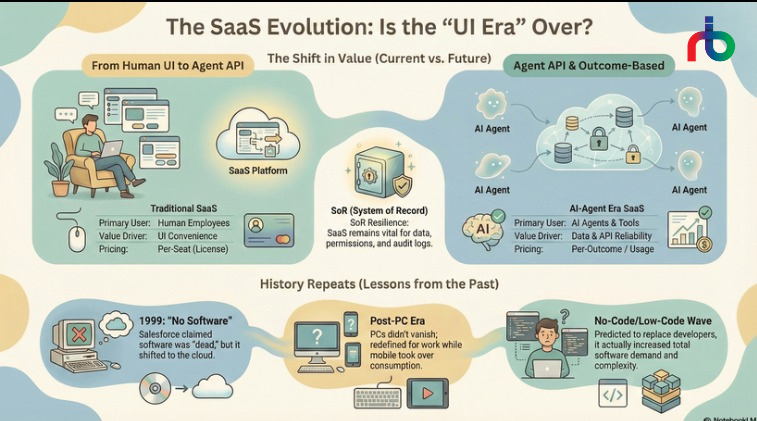
For over a decade, Software-as-a-Service (SaaS) has dominated the global software industry. From CRM and ERP systems to developer tools, SaaS transformed how businesses buy and use technology.
But today, a critical question is emerging:
Is the traditional SaaS model breaking down in the age of AI?
Zoho founder Sridhar Vembu has long argued that the SaaS industry was structurally weak and overdue for consolidation even before the AI boom. Artificial intelligence didn’t create the problem — it accelerated it.
How the Traditional SaaS Model Worked
The classic SaaS playbook relied on:
- Subscription pricing and user licenses
- Feature expansion to justify higher costs
- Dashboards and manual workflows
- Humans operating software daily
This model thrived because software required constant user interaction. More features meant more perceived value.
AI challenges this assumption.
AI Agents Are Changing Software Usage
The real disruption isn’t just AI-assisted development — it’s the rise of AI agents.
AI agents can:
- Understand user intent
- Select the right tools or APIs
- Execute tasks across systems
- Deliver outcomes without dashboards
Instead of using software, users now define goals — and agents handle execution. This fundamentally shifts how software creates value.
From SaaS Tools to Outcome-Driven Systems
In an AI-driven world:
- Users want results, not tools
- Interfaces matter less than orchestration
- APIs matter more than features
- Intelligence becomes the product
This explains why many feature-heavy SaaS platforms feel bloated. When outcomes are automated, complexity becomes friction.
SaaS Isn’t Dead — It’s Becoming Infrastructure
SaaS is not disappearing.
It’s evolving into foundational infrastructure.
The new software stack looks like:
- SaaS platforms providing reliable services and APIs
- AI agents acting as the experience layer
- Orchestration replacing manual workflows
The future belongs to agent-first, composable, and outcome-driven platforms.
What This Means for IT Companies
For IT service providers and product companies, this shift is critical.
Building software only for human operation is no longer enough. The next generation of solutions must be:
- AI-first
- Designed for orchestration
- Focused on business outcomes, not interfaces
Final Thought
SaaS isn’t dead.
But SaaS as we knew it is being rewritten.
The real question is:
Are we building software for people to click buttons — or systems where AI agents execute intent on their behalf?
Those who adapt early will shape the future of enterprise software.
